
The US and its allies must evolve a more comprehensive long-term plan to defeat the new danger that the caliphate poses to the world order. And India too must do its bit for course correction, says strategic expert Gurmeet Kanwal.

'The big power struggle in faraway Europe erupted at a most critical juncture when India has been increasingly sceptical about American policies and statesmanship,' argues Ambassador M K Bhadrakumar.

'India enjoys the maneuverability of a coming big power.' 'It is this possibility that has persuaded Moscow to humour India and stayed Washington from getting punitive about India's neutrality on the Ukraine issue.'
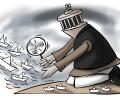
A combination of externalities such as global trade wars and slowing growth, continuing glitches in accessing offsets under the GST regime, which has created a liquidity crunch for smaller exporters, and the growing competitiveness of smaller countries are causing the slowdown.
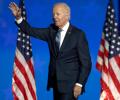
'The hardliners in Delhi are in for a big disappointment,' predicts Ambassador M K Bhadrakumar.

'Washington appears to be playing the long game, and making the argument to India that over the longer term, Russia -- sanctioned, cash-strapped, isolated by the West -- will no longer be a viable defence partner for India'

My candidate for the best general of the last century hailed from a little, poor colonised Asian nation whose impact on world affairs rarely amounted to much, notes Shankar Acharya.
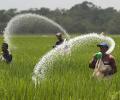
Enthused by rising potato prices after a prolonged slump, Pradeep Sharma was planning to sow the crop on his 15-acre farm near Agra slightly earlier than usual. The delayed departure of the southwest monsoon also prompted his decision, since the good soil moisture would have saved at least one initial irrigation. But the acute shortage of diammonium phosphate (DAP), a crucial nutrient ahead of the sowing season for potatoes, nipped those hopes in the bud. DAP is the second-most used fertiliser in the country after urea.

'India is possibly the most fiscally constrained market in the region.'
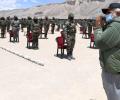
'...but from those who control the narrative.' Powerful nations have mastered this art of narrative building. Those nations who aspire to become global powers must do so, observes Shanthie Mariet D'Souza.

'What needs to be watched is that the border incidents at Dokalam in 2017 and Galwan in 2020 are triggering nascent Chinese nationalism against India,' asserts Srikanth Kondapalli, the leading China expert.

'It is a testing time for our foreign policy which may involve a certain element of taking risks, assessing costs, and expecting failures,' asserts Commodore Venugopal Menon (retd).

'The parallels between 1914 and 2014 are striking. The crumbling of American and Russian hegemony, the rise of powerful terrorist groups, ferment in the Middle East and the rise of China... These closely mirror the world of 1914,' says Colonel Anil A Athale (retd).

Pakistan is once again becoming a frontline State in big-power rivalry. But this time around, Pakistan stands to gain out of its geography, observes Ambassador M K Bhadrakumar.

Historically, tensions in West Asian regions have provided support to gold prices.

One has to wonder what is so wrong with the European Union.

Usually, a fall in oil prices is followed with a cut in retail prices of auto fuels and the government passes on the benefit to consumers. However, Morgan Stanley believes gains this time around will remain capped.

'Devyani -- she is a public servant and her personal life has already received far too much attention -- and her ambitious father now need to retreat to the background so that wiser diplomatic heads restore sanity to India-US relations as India prepares for parliamentary elections,' says Ambassador K C Singh.

While Manmohan Singh had to deal with high oil prices, inflation and trade deficit, Narendra Modi is lucky as major threats have receded, says T N Ninan.

'With technology advancing rapidly, the need for branches is declining.'

'China, which had earlier blockaded New Delhi's bid to join the Nuclear Suppliers Group by citing the nuclear non-proliferation law, finds itself in an awkward position and international isolation.' 'India needs to pursue a policy of mediation between China and the Southeast Asian countries for regional security,' says Srikanth Kondapalli.

Opposition parties on Monday staged a walkout in the Rajya Sabha after their demand for a resolution on Gaza was not accepted.

Sources said China was forcefully pushing for inking the deal during the RCEP summit later in the day, which was seen as an attempt to counter-balance the impact of its lingering trade war with the US as well as to project the region's economic might to the West.
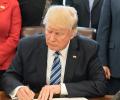
India needs to consider whether the Donald Trump administration can actually deliver, observes former foreign secretary Shyam Saran.

Substantial gains can still be made with good policies and initiatives.

'There is no Buddha or Gandhi among countries, existing for the service of others; they all exist for the good of themselves.' 'For each country, its own interests should be paramount, and it is futile and churlish to expect China to be an exception to this rule,' says B S Raghavan, the distinguished civil servant and long-time China-watcher.

With Beijing having had a profound rethink on India's admission as a full member of the Shanghai Cooperation Organisation, the tectonic plates of the geopolitics of a massive swathe of the planet stretching from the Asia-Pacific to West Asia are dramatically shifting. That grating noise in the Central Asian steppes will be heard far and wide -- as far as North America, says Ambassador M K Bhadrakumar.

This means lower losses on fuel sales by Indian oil companies and a shrinking oil subsidy bill for the government.

'It's waging an offensive with no seeming precedent.' 'The fact that it's now entering cities, as opposed to remaining massed around their perimeters, is a game changer.'
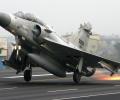
A realistic assessment will tell us that not much has changed between India and Pakistan; the relationship remains as fraught as before with little prospect of reconciliation, notes Ajai Shukla.

The market could be influenced by events elsewhere in the world and regardless of what happens to India's economy

Had India agreed to join the trade pact, Indian markets would have been flooded with cheap Chinese products.

'Right now, politics is operating in a state of suspended animation. That works to Modi's advantage.'

'Perhaps the biggest indication was its striking decision in November to delink LeT from its aid certification process.' 'The administration decided that the US, in order to send military aid to Pakistan, would not need to certify that Pakistan is cracking down on LeT.' 'Perhaps the administration was trying to offer a carrot -- in effect, we're backing off on LeT, but in return we expect you (Pakistan) to go after the Haqqanis.' 'Either way, the optics were dreadful for the US given that Hafiz Saeed was released from house arrest a few days after the US move.' 'The US reacted angrily, but eventually it moved on, and refocused on its core concern: The Afghan-focused terror groups.'
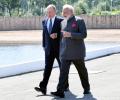
'The Vladivostok visit marks a subtle reversal of trend discernible in the revival of India-Russia relations pioneered by Modi during the past couple of years,' says Ambassador M K Bhadrakumar.
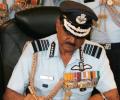
India and the United States discussed a host of issues, including the security situation in South Asia, East China Sea, anti-piracy operations and America's help in developing two new commands -- space and cyber, during a recent visit of Air Chief Marshal N A K Browne in Washington.

How China's all powerful Communist party bungled the response to the coronavirus crisis.
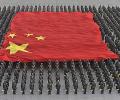
The sudden proximity between India and US has, in the eyes of many, sidelined China. This is not the case, argues Colonel Anil A Athale (retd).

The US #DeepState has had a fine run, but will now discard Saudi Arabia as it is no longer useful to them, says Rajeev Srinivasan.

Stupidity knows no boundaries just like smartness, oxygen, and maybe football, says Maharaj Damodardas.
